
Loons
The Common Loon, with its haunting, melodic, eerie, and hypnotic calls, makes lake residents look forward eagerly to the arrival of loons every year. It’s important to monitor the flock and help keep it alive and well. The annual loon count is one way to do this. Watching for and reporting abnormal loon behavior—a loon in distress—is another. This page describes the loon count as well as characteristics of distressed loons so you know when to make a report.
Loon Count
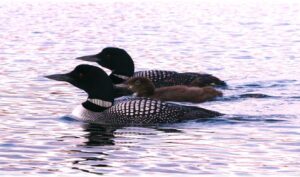 Every year, Maine Audubon gathers information about the numbers of loons on Maine lakes to better understand trends in the loon population. Androscoggin Lake is fortunate to have a healthy loon population that has more than tripled since 1983, the year the Maine Loon Count was introduced.
The goal of the count is for volunteers to provide an accurate count of the loons on their lake. Counting loon adults and chicks is important because it provides the first indication of problems with our loon population.
The count is held on the third Saturday in July, from 7 am to 7:30 am. During this time, volunteer counters document the positions of loons on their lakes. Because each participating lake group performs the count at the same time, in theory no loons are counted twice.
Because of its size, Androscoggin Lake is divided into eight sections. Each one is assigned to a volunteer(s) who patrols it in a motorboat, looking for adult loons, chicks, and nests with eggs. Once a loon is spotted, the volunteer records its location along with the precise time on a map provided by the loon count coordinator. The coordinator then submits the information to Maine Audubon.
Androscoggin’s coordinator is Tom Wells. Please contact us if you would like to participate in this year’s count in July.
The Lake Stewards of Maine provide an interactive map of loon data. Click the loon icon on Androscoggin Lake to view historical data.
Loons in Distress
Common Loons sometimes find themselves in uncommon situations. It is important to be able to distinguish between genuine distress versus normal (but odd-looking) behaviors that may be mistaken for distress.
Recognizing Loons in Distress
Below are several of the most common scenarios that indicate that a loon is in distress and warrant reporting. Please do not try to rescue a loon yourself. Their bills are sharp and they can be difficult and dangerous to handle.
Beached or stranded loons: Healthy loons spend the majority of their time in the water, only coming up on land to nest. If a loon is on land and not on a nest, it may be in trouble. When flying, loons may mistake wet pavement (roads or parking lots) for water and try to land there. Because loons cannot walk or take off from a dry surface, landing in these places renders them stranded.
Tangled loons: Because they use their bills to clean themselves, loons that encounter fishing line often end up with the line wrapped around their bills, and the more they try to free themselves, the more tangled they become. Or, they may accidentally swallow a lure or fish on a line, leaving the line trailing.
Trapped in ice: Loons require a long runway, generally at least 100 yards and sometimes up to a quarter of a mile of open water, in order to take off. If they remain on lakes too long, they can become trapped as the ice closes in around them.
Deceased loon: Since loons can carry diseases that can be spread through touch, please do not attempt to collect it yourself.
Abandoned or floating egg: Please take a picture of the location of the egg and report it with suspected cause. Do not attempt to collect it.
Recognizing Loons Not in Distress
Sometimes people mistake ordinary loon behavior for distress. Loons perform actions that maintain the waterproofing and general condition of their feathers. The two basic activities are preening and bathing.
Preening: A preening loon may roll onto its back or side and use its bill to pull at its breast and belly feathers; stick one leg in the air and paddle in circles; rub its head against its back and shoulders to disperse oil; flap its wings hard and rise out of the water (appearing unable to take off); and shake its wings, head, and tail.
Bathing: Loons splash vigorously, submerge themselves in the water, and may scoot upside down across the surface of the water. They may also completely roll over while thrashing in the water with partially open wings; flail one or both wings in the air; slap or beat the water’s surface with their wings; dive backwards into the water; and submerge their heads underwater and thrash.
Reporting a Loon in Distress
Contact us to report a loon in distress.
Provide as much of the information below as possible:
- The location of the loon: please be as specific as possible. If the loon is on land, please provide the nearest house number or another landmark. If the loon is in the water, please provide landmarks such as the name of a cove, beach, or island that it is in or near.
- The loon’s behavior: what is the loon doing? What is making you think that it is in distress? Is it swimming? Diving? Feeding? Preening? Does it swim in circles or float lopsided in the water? Does it beach itself? Can you see fishing line around the bill or body? Does the loon appear to be trying to remove something with its bill?
- For tangled loons: Do you see fishing line on the loon? If so, is the line wrapped around the loon’s bill, or is it on another part of the loon’s body? Does the loon seem to be able to dive?
- A picture (or video) is worth a thousand words! When possible, please take a photo or video to send. This helps us to better evaluate the situation and develop a rescue plan.
With thanks to the Loon Preservation Committee and the Vermont Center for Ecostudies for giving us permission to share some of their content about loons in distress.